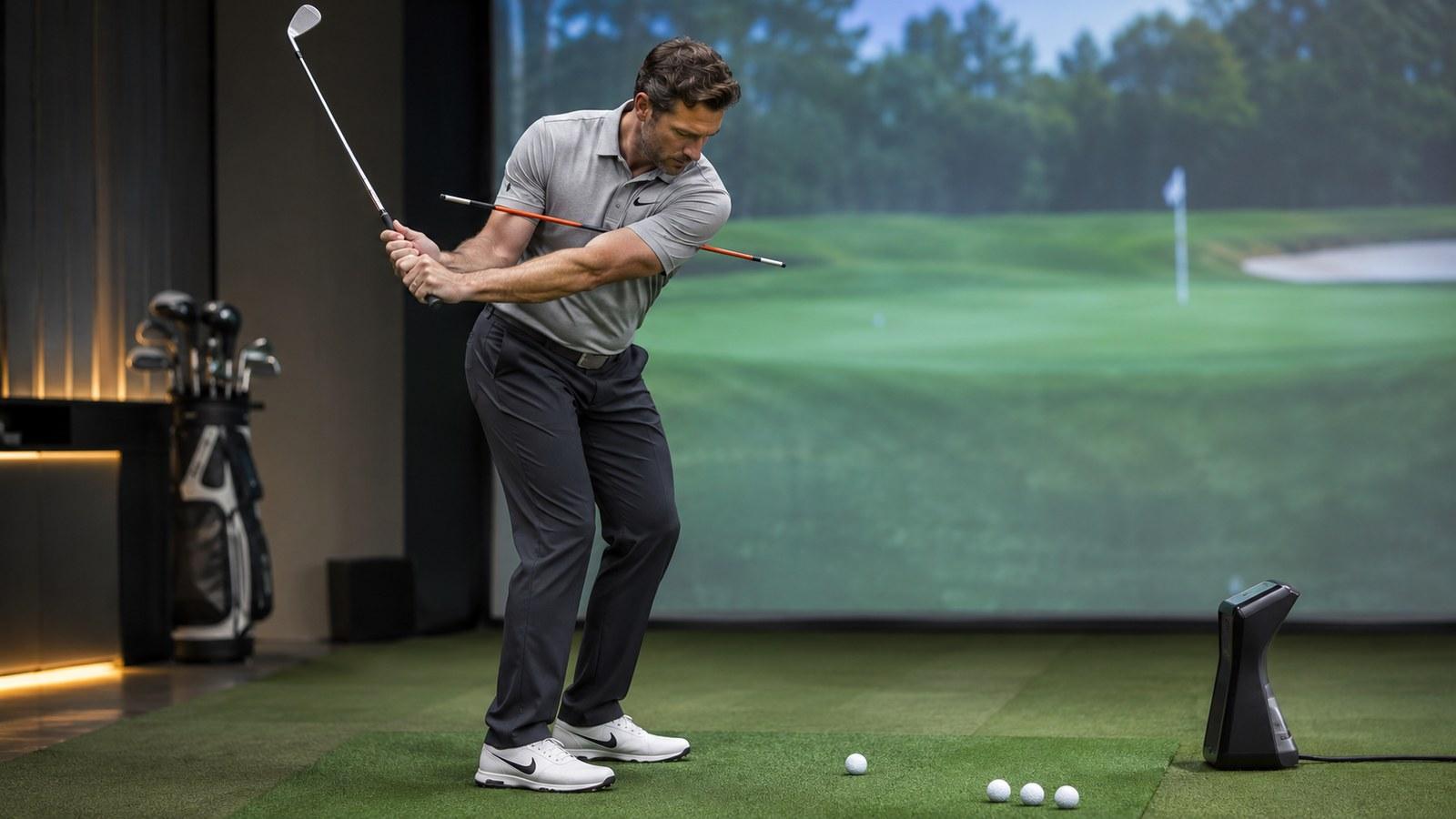
Landon Ashworth's pitching lesson matches shoulder turn to wrist hinge
The former +7 uses one 60-degree wedge inside 90 yards, an alignment rod to measure his turn and a four-ball practice game that doesn't count bogeys.
By The Perfect Lie Golf Desk / 1 source / Published November 15, 2026
Landon Ashworth is rebuilding his game from the hole backward after wrist surgery. He played to a +7 handicap before the operation and spent eight months away from golf. After lessons on putting and chipping, the newest video in his Back to Plus series, posted Nov. 12, moves to pitching. Ashworth, who is autistic, says his brain likes systems, and this one rests on matching how far he turns to how far he hinges. He also says up front that he isn't a PGA-certified coach. He calls himself "just a player that's really good."
- YouTube
A +7 Autistic Golfer's Approach to Pitching
Read source ↗ His system has five main parts.
1. One wedge inside 90 yards
Ashworth hits a 60-degree wedge with 6 degrees of bounce on every shot from greenside out to 90 yards. He practices with his sand wedge, 52 and pitching wedge too, but doesn't use them on the course, because he knows what the 60 will do from any distance.
Free to play
Make your call with Beat Chuck
Check the challenge board for the latest open games.
All Beat Chuck games →
2. An alignment rod measures the turn
He sets an alignment rod at the same shaft angle as his club and uses it as a gauge. On a 10-yard shot his turn reaches about the sticker on the rod, on a 20-yarder just above it and on a 30-yarder about halfway up. Each hinge length gets its own turn. At 60 yards his shaft is about parallel to the ground at the top, with roughly 80% of his weight on the inside of his right foot, mostly on the heel.
3. A pitch is a chip
Ashworth sees no difference between a pitch and a chip. The only things that change between a pitch and his driver, he says, are ball position and how far he hinges and turns. Through the ball his body has to keep moving left. If it stops, he says, you chunk it or skull it.
4. Ball position sets the height
The ball goes in the center of his stance for a stock shot, forward when greens are firm and he needs it to stop, and back when he wants rollout. On an uphill lie he moves it back and rates the slope. A "five" means 5 feet of extra rollout, so on a 10-yard chip he makes his 9-yard swing. From a plugged lie he plays it further back and hits down. From thick rough he closes the face before taking his grip and swings for about 10 extra yards, so a 20-yard chip gets his 30-yard swing.
5. A practice game with no bogeys
He tosses four balls about 10 yards apart around one target and has to get each one in the hole in two shots or fewer. A hole-out paired with a three doesn't count, because bogeys are unacceptable. From 50 yards he wants all four inside 3 feet. Short of that, he says, he would spend three or four weeks on the drill before moving back to 90, 120 or 150 yards.
The video was shot at Talking Stick Golf Club. The rod-and-turn drill also works on a simulator range, where carry numbers show right away whether each hinge-and-turn pairing produces the same distance.