Make your picks. Beat the host.

Take on Chuck in quick sports prediction challenges.

Find a golf challenge
Triple Bogey Golf's Optoma test puts the simulator screen shape in focus cover
Back to The Perfect Lie

Triple Bogey Golf's Optoma test puts the simulator screen shape in focus

The ZK608TST review compares room lighting, then shows why a 4:3 impact screen limits a native 16:9 projector installation.

Share this article

FacebookLinkedInXEmail
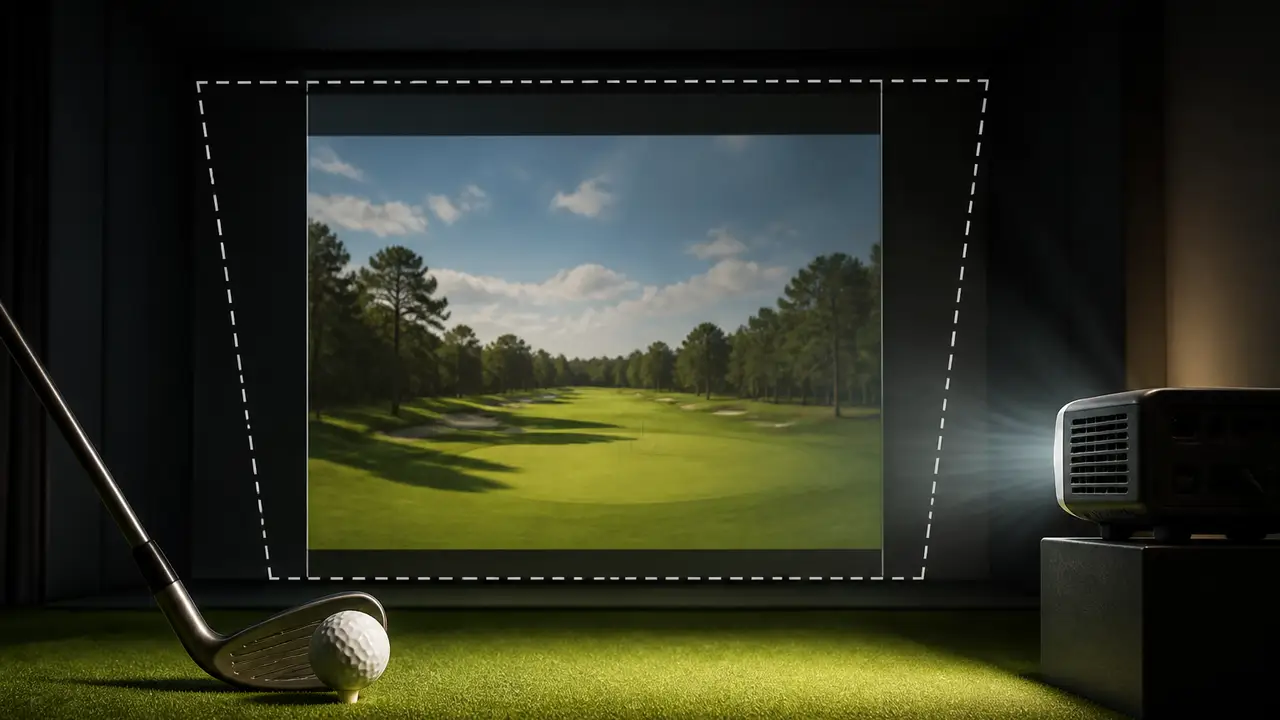
  • Triple Bogey Golf's new Optoma ZK608TST test finds a problem beyond picture brightness: the creator likes the image enough to reconsider his simulator's screen shape. His room uses a 4:3 impact screen, while the projector's native image is 16:9.

    The October 5 video tests the projector in the Triples Happen Studio, including footage of MrShortGame reacting to the screen. The creator describes a roughly $6,000 price bracket and discloses that Optoma provided the projector at no cost for review. His impressions are a report from that installation, with the supplied equipment relationship stated in the video's description.

  • YouTube

    Triple Bogey Golf: “What Projector Are You Running?!” — MrShortGame

    Read source
  • The ambient-light comparison is useful because the creator shows the same content in a dark room, under his normal lighting and with practical lights and windows open. He says the camera's exposure, contrast, white balance and projector mode remain fixed. He also explicitly says he has no light meter. Viewers can compare the filmed conditions without treating them as a measured brightness test.

  • Make your call with Beat Chuck

    Check the challenge board for the latest open games.

    All Beat Chuck games →
    Golf Chuck
  • Optoma lists the ZK608TST at 6,000 lumens, with UHD resolution of 3840 by 2160. Its official specification gives a 0.58:1 throw ratio, a fixed lens and manual horizontal and vertical lens shift. Those details make the mounting position part of the purchase decision: a fixed lens lacks the optical zoom that could otherwise adjust image size from a chosen location.

    The screen discussion shows a separate constraint. When the creator changes from his usual 4:3 setting to 16:9, the wider image extends beyond the usable screen area onto the walls. He likes the existing picture but wishes his room could accommodate the projector's full native image shape. The usable screen area limits how much of that wider image the installation can show.

    For an owner planning an upgrade, that is a useful order of questions. Establish the usable screen width and height, then work out where the lens can project the chosen image without interfering with the swing area. Consider how the room is lit during actual play. A bright image in someone else's simulator answers only part of that planning problem.

  • Triple Bogey Golf finishes by questioning whether to rebuild his screen area. His favorable review is specific to a permanent installation with ambient light and a mounting position that suits this projector. The room's geometry remains the deciding detail.